









Hoppenhelm


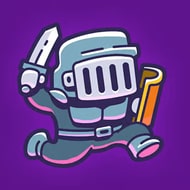
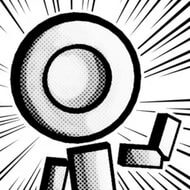
Sir Hoppenhelm cannot walk — hopping forward one space at a time is the only way this knight moves through the dungeon of Castle Dunkelburg, and that single restriction shapes every decision the game asks of you.
Three Buttons, One Dungeon
Movement, offense, and defense are split across three distinct inputs: hop, attack, and block. Hopping advances the knight forward exactly one space at a time, attacking clears whatever hazard sits directly ahead, and blocking absorbs a hit that would otherwise end the run. None of these three actions happen automatically — every hop, swing, and block has to be chosen individually, which turns a dungeon crawl that could have been a simple runner into something closer to a rapid-fire decision tree.
The dungeon itself is populated with a steady stream of hazards — blobs, snakes, and guillotines among them — and each one demands a different one of the three inputs to survive. A blob blocking the path ahead might call for an attack, while a swinging guillotine timed wrong calls for a block instead, and mixing up which hazard needs which response is one of the fastest ways to end a run early.
The Floor Turns Deadly If You Hesitate
The ground beneath Sir Hoppenhelm doesn’t stay safe indefinitely — hesitating too long on a single space causes the floor there to become lethal, which removes the option of pausing to think through a tricky sequence of hazards. That time pressure is layered on top of the hop-attack-block decision-making, meaning the actual difficulty isn’t just picking the right input, it’s picking it fast enough that standing still isn’t a viable fallback option.
A hammer is one of the unlockable weapons, specifically useful against spike blocks that other weapons can’t clear as reliably, which means weapon choice going into a run isn’t purely cosmetic — a knight equipped with a hammer approaches a spike-heavy stretch of the dungeon differently than one without it.
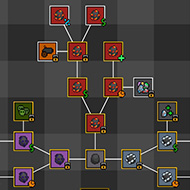
Dying repeatedly is actually part of the intended loop rather than a failure state to avoid entirely — coins collected across runs, including failed ones, accumulate toward unlocking new knights and weapons. Some of those unlocked knights lean toward earning more coins per run, while others trade that for greater durability or stronger combat performance, so the choice of which knight to unlock and use next becomes its own layer of strategy on top of the moment-to-moment hop-attack-block decisions.
What players get wrong when starting out
New players tend to default to hopping forward as fast as possible, treating attack and block as reactions to use only when a hazard is unavoidable. In practice, reading two or three spaces ahead and choosing the right input before reaching a hazard — rather than reacting once it’s already adjacent — is what separates runs that climb steadily from ones that stall out on the same early hazard repeatedly.
A frequent point of discussion among players is how unforgiving the deadly-floor timer feels on longer runs, since it removes any chance to simply pause and study an unfamiliar hazard combination — some find that pressure exciting, others consider it the single harshest part of an otherwise approachable game, and neither view has fully won out within the community.
- Hop advances the knight one space; attack clears a hazard directly ahead; block absorbs an otherwise fatal hit
- Standing still too long turns the current floor space lethal, forcing constant forward decision-making
- Coins earned even from failed runs accumulate toward unlocking new knights and weapons like the hammer
Hoppenhelm never lets Sir Hoppenhelm walk, run, or pause for long, and that restriction — one hop at a time, three inputs, a floor that punishes hesitation — is exactly what turns Castle Dunkelburg’s dungeon into a puzzle that has to be solved at speed rather than studied at leisure.
Comments
There are no reviews yet. Be the first one to write one.
