












Tomb Of The Mask



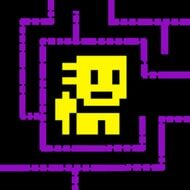
Tomb of the Mask looks like a simple maze climber from a single screenshot, but it plays like a game that refuses to let you change your mind mid-swipe — once the masked character starts moving in a direction, it keeps going until it physically hits something.
| Genre | Arcade / Maze Climber |
| Core Mechanic | Swipe-directed movement that continues until it hits a wall |
| Controls | Swipe in four directions |
| Content | 700 stages across 13 colors and 6 textures |
Movement That Doesn’t Stop Until You Hit Something
A single swipe sends the masked character moving in that direction continuously — there’s no tap-to-step, no partial movement. The character only stops when it collides with a wall or obstacle, which means every swipe has to be planned around what’s actually in that direction, not just the next visible tile. Committing to a swipe too early, before seeing what’s further down that path, is how most unplanned deaths happen.
Coins are scattered throughout each stage and collected automatically along the character’s path, but the real objective is reaching the exit while avoiding whatever traps and enemies the stage places in the way. Because movement can’t be interrupted once started, a swipe toward an exit that has an enemy positioned partway along that same line is often a mistake that can’t be corrected once it’s already in motion.
The Magic Mask and Wall-Zipping
A leveling system unlocks masks and other bonuses over time, and the signature mask lets the character zip directly across walls with a single quick swipe rather than being blocked by them. This changes route-planning substantially — a stage that looks like a dead end without the mask can have an entirely different, faster solution once wall-zipping becomes available, and experienced players often route stages specifically around exploiting that mask rather than the walk-and-stop movement they started with.
Every stage generates in one of thirteen colors and six textures, for seventy-eight possible visual combinations. Colors cycle every five stages and textures every ten, so the visual identity of the maze shifts on a predictable rhythm even as the underlying difficulty of obstacle placement continues climbing independently of what color or texture a given stage happens to be wearing.
Each stage contains a set number of dots and coins to collect along with exactly three stars, and reaching the exit with all three collected is a noticeably higher bar than simply surviving to the exit at all. Across 700 total stages, the density of enemies and traps escalates steadily, and by the later stages a single swipe often has to be timed around multiple moving threats rather than just one static wall.
What new players get wrong first
Swiping reflexively toward the nearest open path, rather than reading how far that path continues before the character will actually stop, causes most early deaths. Since the character can’t be redirected mid-swipe, planning the full length of a movement before committing to it matters far more here than in games where direction can be adjusted on the fly.
- Does collecting all three stars matter for finishing the stage? Reaching the exit clears the stage regardless, but collecting all three stars is a separate and harder benchmark that dedicated players treat as the real measure of a clean run.
- Is the mask always active once unlocked? It functions as a bonus tied to the leveling system, and its wall-zipping effect changes how a stage can realistically be routed once it’s in play, compared to relying on standard walk-and-stop movement alone.
Tomb of the Mask never adds a second control beyond the four-directional swipe, but the combination of momentum that can’t be interrupted mid-move and a wall-zipping mask that rewrites how routes work is enough to keep 700 stages from ever feeling like the same maze twice.
Comments
There are no reviews yet. Be the first one to write one.
