








Geometry Dash
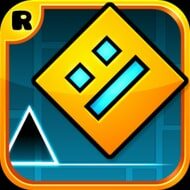
What happens when your Cube touches a spike a half-second before the practice checkpoint you meant to place? In Geometry Dash the answer is simple and unforgiving — the run ends instantly and you’re back at the start, because this game has never offered partial credit for a jump that was almost right.
One Input, Several Forms
The icon at the center of every level constantly changes what it is and what tapping does to it. As the Cube, a tap makes it jump. Switch into the Ship form and the same tap becomes hold-to-rise, release-to-fall flight. The Ball reverses gravity with each tap instead of jumping. The UFO hops in place in mid-air on each press, the Wave and Dart forms fly at a fixed diagonal angle while held, the Robot’s jump height scales with how long you hold the button, and the Spider instantly flips gravity and teleports the icon to the nearest solid surface. None of these forms behave like the others, so a level that swaps between three or four of them in quick succession is really asking you to relearn your timing mid-run.
This constant re-mapping of what a single tap does is the real reason Geometry Dash levels feel harder than their obstacle count suggests. A player who has mastered Cube timing can still die instantly the moment a level drops them into Wave form, because holding too long in Wave sends the icon into a hazard that a well-timed Cube jump would have cleared easily.
Levels are also organized into difficulty tiers, from the most basic introductory stages up through much harder rated levels, and the jump in expected precision between the lower and upper tiers is steep enough that players usually spend far longer on the harder difficulties than the earlier ones combined.
Practice Mode Changes How You Learn a Level
Practice Mode lets a player drop checkpoints anywhere during a run, and dying respawns at the last checkpoint instead of sending the run all the way back to the beginning. This sounds like a minor convenience until you’re facing a level with a brutal section two-thirds of the way through — without Practice Mode, every attempt at that section means replaying everything before it first.
Progress earned in Practice Mode is tracked separately from normal-mode completions, and it doesn’t count toward the level’s official completion reward. That distinction matters to players chasing a legitimate clear: Practice Mode is where the muscle memory gets built, but the run that actually counts has to be done blind, without checkpoints, from the very first obstacle.
Because of that separation, a common pattern among dedicated players is to grind a hard section in Practice Mode until it becomes near-automatic, then attempt a full normal-mode run purely on the confidence that section built. Players in the community often refer to this as “practicing in” a level before going for the real clear, and it’s treated as a completely normal part of tackling anything above the easier difficulty tiers.
Why the Icon Form Matters More Than the Obstacle
New players tend to stare at the spike or the gap directly in front of them, when the actual variable that decides whether they survive is which form the icon is currently in. The same visual obstacle can be trivial in one form and a guaranteed death in another, so reading the upcoming form transitions ahead of time — rather than reacting to hazards one at a time — is what separates players who clear a level in dozens of attempts from those who need hundreds.
There’s also a specific moment recognizable to anyone who’s spent real time with Geometry Dash: the brief silence right before a level’s music drops into its most intense section, which almost always lines up with the hardest obstacle sequence in the whole run. Once you’ve died there enough times, that half-second of quiet stops feeling like a breather and starts feeling like a warning.
- Cube and Ball forms reward short, precise taps rather than held inputs
- Ship, Wave, and Dart forms punish holding the button a fraction too long
- Robot’s jump height scaling means the same tap can clear very different obstacle heights depending on hold duration
- Why does my run keep failing at the exact same spot even after checkpoints? Practice Mode checkpoints only help you rehearse the section — the actual completed run still requires clearing that same section blind, without the safety net, which is why a spot that feels solved in practice can still end a live attempt.
- Does Practice Mode progress count toward finishing the level? No — completions tracked in Practice Mode are kept separate from normal mode, so only a full run without checkpoints counts as an official clear.
- Why does the same obstacle feel completely different on a second attempt? It’s almost always a form change — an obstacle that was easy as a Cube can be lethal in Wave or Ship form, so the icon’s current shape matters as much as the obstacle’s shape.
Geometry Dash keeps its core rule simple — one tap, instant death on contact — and builds all of its real difficulty out of how often it changes what that one tap does, which is exactly why a Cube-only tutorial run and a Robot-and-Spider-heavy endgame level can share the same control scheme and feel like two different games entirely.
Comments
There are no reviews yet. Be the first one to write one.
