









G-Switch 4


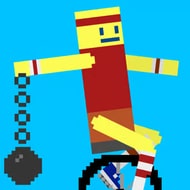


G-Switch 4 looks like a simple runner where you flip gravity to dodge spikes, but it plays like a split-second reflex test where a single mistimed click drops you straight into the ceiling saws you were trying to avoid.
Flipping Floor and Ceiling on Command
The entire control scheme is one click or tap: press it and your runner flips from the floor to the ceiling, or back again if it’s already on the ceiling. There’s no jump button, no second input, nothing to hold — G-Switch 4 keeps the mechanic deliberately narrow so that everything hard about the game comes from timing and pattern reading rather than complexity of controls.
The main campaign runs through eight story levels, and each one is built to introduce a new obstacle type before combining it with everything that came before. Early levels mostly ask for a clean single flip past a gap or a spike row. By the later levels you’re reading speed tiles, springs, spinning saws, and diagonal platforms in the same stretch of track, often with barely enough runway between them to register what’s coming next.
Speed tiles push your runner into a faster pace for a short stretch, which compresses your reaction window for everything that follows — a flip timing that worked at normal speed will be too slow once a speed tile kicks in, so players have to consciously recalibrate rather than relying on the rhythm they’d built up before it.
Up to Eight Players, One Screen
G-Switch 4 supports local multiplayer for up to eight people on the same device, with each player assigned a different key, mouse click, or gamepad button. Everyone runs the same track at the same time, and the obstacles don’t discriminate between players — a saw that catches one runner catches all of them equally if they’re not paying attention.
This shared-track format changes how the game gets played in practice. In solo runs, a near-miss is just a near-miss. In an eight-player race, the same near-miss next to a friend who cleared it cleanly becomes the moment that decides who’s still alive by the end of the level, which is a large part of why G-Switch 4 gets played in groups far more than most runners in its genre.
There’s also a level creator built into the game, letting players design their own gravity-flip tracks and share them, which means the eight-level campaign is really just the starting point rather than the full extent of what’s available to run.
What beginners consistently get wrong
New players tend to click reactively the instant they see an obstacle, rather than timing the flip to land cleanly on the new surface. Because gravity flips instantly and momentum carries over, a flip triggered too early sends the runner into whatever’s waiting on the other surface just as hard as flipping too late does — the window for a clean flip is narrower than the single click makes it feel.
Difficulty in G-Switch 4 doesn’t come from new controls appearing later on; it comes entirely from stacking existing obstacle types closer together and faster, so a section near the end of the campaign uses the exact same one-click flip as the tutorial and is still dramatically harder to clear. Players who’ve run the full eight levels tend to describe the later stages less as “new challenges” and more as “the early challenges with no room left to breathe,” which is a fair description of how the difficulty curve actually works here — the game is played, not read about, and that compressed pacing is something you only really feel once you’re the one clicking.
Comments
There are no reviews yet. Be the first one to write one.
