






Doodle Jump

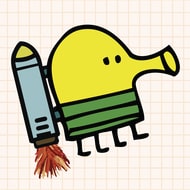
You tap the tilt controls a beat too late, the platform you needed vanishes off the bottom of the screen, and the Doodler drops through empty space while the score counter freezes on a number you were sure you could beat. That single moment of overcorrecting is the entire rhythm of Doodle Jump distilled into two seconds, and it’s why the game still gets brought up in casual mobile gaming circles more than a decade after it first spread across phones.
| Genre | Vertical platformer / endless climber |
| Platform | Mobile touchscreen devices |
| Objective | Climb as high as possible without falling or getting hit |
| Core Mechanic | Tilt-based movement with automatic jumping |
How the Doodler Actually Moves
The Doodler never stops jumping on its own; your only real job is steering it left and right by tilting the device, which means the game is less about timing jumps and more about reading the next platform before you’ve even landed on the current one. Green platforms are safe and solid, but blue platforms crumble the instant they’re touched, and that distinction is something every new player learns the hard way within the first thirty seconds.
Momentum carries further than most players expect. If you’re mid-tilt when you land on a platform, the Doodler keeps drifting in that direction on the next bounce, which is why screen-edge wraparound becomes second nature fast — exit right, reappear left, without losing height.
Fold-out platforms, the ones that snap sideways after one bounce, force a different kind of reaction. You can’t linger on them, and players who try to line up a perfect jump often waste the platform’s only usable bounce.
Power-Ups and What They Actually Fix
Doodle Jump hands out a small, memorable set of boosts, and each one solves a different problem instead of just adding a generic speed buff. The Propeller Hat gives a short stretch of controlled flight, useful for correcting a bad platform read. Spring Shoes add extra bounce height on a single platform. The Jetpack is the one most forum threads mention by name, since it launches the Doodler almost off the top of the visible play area and skips a dangerous stretch of platforms entirely.
- Trampoline — a permanent-feeling boost that survives on a platform until used
- Rocket — vertical thrust that clears UFOs and black holes in one motion
- Star — brief invincibility against monster collisions
Score-focused players treat the Jetpack differently than casual players do. Where a beginner grabs it reflexively, someone chasing a leaderboard number will sometimes delay picking it up by a platform or two to land on a bonus item first.
Enemies That Break the Rhythm
The UFO is the first real threat most players meet, drifting horizontally and firing shots that knock the Doodler down several platforms on contact. It’s avoidable with a clean sideways dodge, but panic-steering into it is one of the most common early deaths in the entire game. Black holes are worse — they pull the Doodler in from a noticeable radius, and once caught, there’s no escaping the drop.
Higher up, the green one-eyed monster shows up more often, and unlike the UFO it doesn’t fire at range; it simply blocks a platform outright. Some players jump on its head for a bounce, others avoid it entirely, and that split is a real point of disagreement in Doodle Jump discussion threads.
By the time you’re several thousand points in, all three threats can appear close together, and that stacking is where most long runs actually end.
Why the Difficulty Curve Frustrates Some Players
Doodle Jump doesn’t ramp up smoothly, and that’s one of the more debated aspects of the game. Platform density thins out unpredictably the higher you climb, and a run can feel generous for a stretch and then suddenly demand a near-perfect string of reads. Some players find this tension part of the appeal; others describe it as luck-dependent in a way that undercuts skill.
What’s not really in dispute is that muscle memory matters more than reaction speed. Recognizing a fold-out platform’s shape before you land on it, at a glance, is a skill built over dozens of runs, not something you can think through in the moment.
What score should I actually be aiming for in Doodle Jump?
There’s no fixed benchmark, but casual players typically plateau somewhere in the low thousands, while players who’ve internalized the wraparound and fold-out timing regularly push into the tens of thousands. The gap comes almost entirely from platform reading, not reflexes.
Why does the Doodler die from falling instead of hitting an enemy?
Falling off the bottom of the visible screen ends the run instantly, which surprises new players more than enemy contact does, since a UFO hit just knocks you down rather than ending things outright. Losing height near a black hole or a cluster of blue platforms is the more common actual cause of death.
Is there a way to avoid the black hole reliably?
The safest approach is lateral movement well before the pull radius, since the black hole’s suction strengthens the closer you get; players who wait until the last platform to dodge usually get caught.
Doodle Jump earns its long shelf life from how little it asks of a player up front and how much it rewards the ones who stick with it — a Jetpack grabbed at the right moment, a clean dodge around a black hole, a fold-out platform read correctly on instinct rather than guesswork. None of that comes from luck alone, even on the runs where the platform spacing seems determined to prove otherwise.
Comments
There are no reviews yet. Be the first one to write one.
